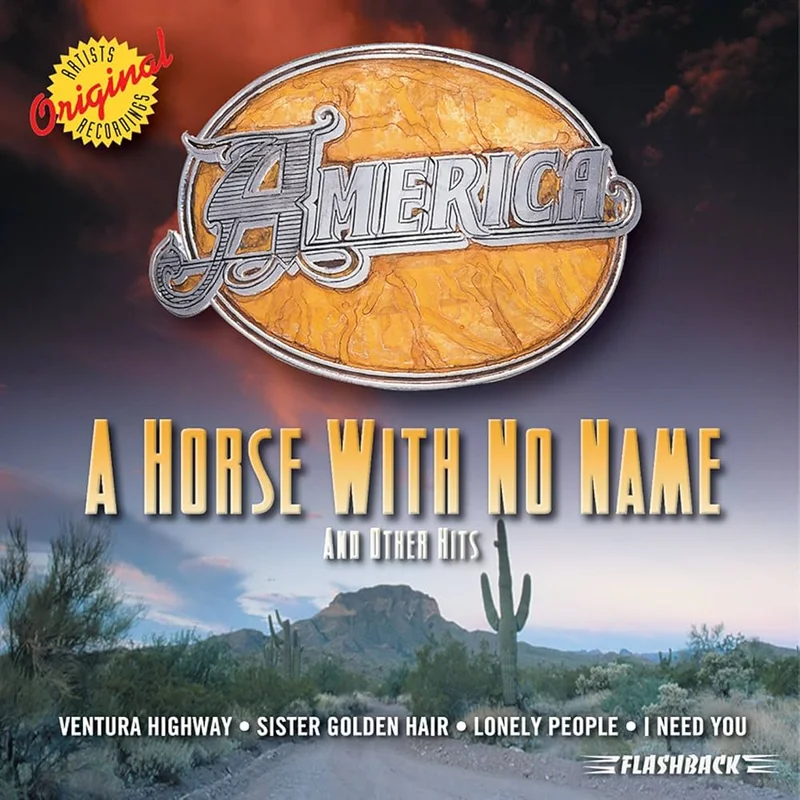
AHorsewithNoName
America, George Martin
America
A nameless rider crosses the desert of the soul and finds silence louder than any city.
On the first part of the journey
I was looking at all the life
There were plants and birds and rocks and things
There was sand and hills and rings
The first thing I met was a fly with a buzz
And the sky with no clouds
The heat was hot and the ground was dry
But the air was full of sound
I've been through the desert on a horse with no name
It felt good to be out of the rain
In the desert you can remember your name
'Cause there ain't no one for to give you no pain
La, la, la lala la la la, la, la
La, la, la lala la la la, la, la
After two days in the desert sun
My skin began to turn red
After three days in the desert fun
I was looking at a river bed
And the story it told of a river that flowed
Made me sad to think it was dead
You see
I've been through the desert on a horse with no name
It felt good to be out of the rain
In the desert you can remember your name
Because there ain't no one for to give you no pain
La, la, la lala la la la, la, la
La, la, la lala la la la, la, la
And after nine days I let the horse run free
'Cause the desert had turned to sea
There were plants and birds and rocks and things
There was sand and hills and rings
The ocean is a desert with its life underground
And a perfect disguise above
Under the cities lies a heart made of ground
But the humans will give no love
You see
I've been through the desert on a horse with no name
It felt good to be out of the rain
In the desert you can remember your name
'Cause there ain't no one for to give you no pain
La, la, la lala la la la, la, la
La, la, la lala la la la, la, la
La, la, la lala la la la, la, la
La, la, la lala la la la, la, la
On the first part of the journey
I was looking at all the life
There were plants and birds and rocks and things
There was sand and hills and rings
The first thing I met was a fly with a buzz
And the sky with no clouds
The heat was hot and the ground was dry
But the air was full of sound
I've been through the desert on a horse with no name
It felt good to be out of the rain
In the desert you can remember your name
'Cause there ain't no one for to give you no pain
La, la, la lala la la la, la, la
La, la, la lala la la la, la, la
After two days in the desert sun
My skin began to turn red
After three days in the desert fun
I was looking at a river bed
And the story it told of a river that flowed
Made me sad to think it was dead
You see
I've been through the desert on a horse with no name
It felt good to be out of the rain
In the desert you can remember your name
Because there ain't no one for to give you no pain
La, la, la lala la la la, la, la
La, la, la lala la la la, la, la
And after nine days I let the horse run free
'Cause the desert had turned to sea
There were plants and birds and rocks and things
There was sand and hills and rings
The ocean is a desert with its life underground
And a perfect disguise above
Under the cities lies a heart made of ground
But the humans will give no love
You see
I've been through the desert on a horse with no name
It felt good to be out of the rain
In the desert you can remember your name
'Cause there ain't no one for to give you no pain
La, la, la lala la la la, la, la
La, la, la lala la la la, la, la
La, la, la lala la la la, la, la
La, la, la lala la la la, la, la
“A nameless rider crosses the desert of the soul and finds silence louder than any city.”
In 1971, Dewey Bunnell was barely twenty years old and already homesick for a landscape he had never truly inhabited.
The son of a U.S.
Air Force serviceman stationed in England, Bunnell had spent fragments of his childhood in the American Southwest, and those sun-scorched memories — half-real, half-imagined — coalesced into a song he wrote in his bedroom in Hatfield, Hertfordshire.
The desert he conjured was not a literal place but a composite: part childhood road trips through the scrublands of Vandenberg Air Force Base in California, part the arid expanses glimpsed in Salvador Dalí paintings and the psychedelic Westerns filtering through late-sixties counterculture.
He has often said the song simply "poured out," an exercise in free-association imagery that he initially considered too strange, too naïve, to show his bandmates Gerry Beckley and Dan Peek.
But when he finally played it for them, they heard something luminous in its simplicity — a kind of waking dream set to two chords.
The recording that would reach the world was captured at Trident Studios in London's Soho district, with the legendary George Martin — still basking in the afterglow of his Beatles productions — behind the console.
Martin's touch on "A Horse with No Name" is a masterclass in restraint.
Where a lesser producer might have gilded the arrangement with orchestral flourishes, Martin understood that the song's power lay in its hypnotic spareness.
The track is built on an insistent, gently strummed pattern alternating between E minor and D6add9 — two chords that hover in a kind of modal ambiguity, never fully resolving, mirroring the endless horizon of the lyric's desert.
Bunnell's nylon-string acoustic guitar provides the skeletal frame, while Beckley layers a second guitar with a subtly different voicing, creating a shimmering stereo field.
Peek's bass guitar pulses underneath with a simplicity bordering on the meditative.
The percussion — a combination of light bongos and congas rather than a conventional drum kit — gives the track an earthy, almost tribal heartbeat.
Martin's most crucial decision may have been what he chose to leave out: there are no electric guitars, no keyboards, no brass.
The production breathes like desert air, and the three-part vocal harmonies, stacked with a closeness that recalls the Crosby, Stills & Nash school of California folk, float above the arrangement like a mirage.
Lyrically, the song unfolds as a journey in three acts, each deepening the narrator's encounter with solitude.
The opening verse is almost childlike in its cataloguing — "plants and birds and rocks and things" — a line that critics would mock for decades but that carries its own disarming honesty, as if the traveler is seeing the world with fresh, unfiltered eyes.
The "fly with a buzz" and "the sky with no clouds" are sensory snapshots, stripped of literary pretension, and their plainness is precisely what makes them stick.
The chorus delivers the song's central paradox: the desert, a place of deprivation, becomes a place of liberation.
"It felt good to be out of the rain" inverts our usual associations — rain as life-giving, desert as punishing — suggesting that the narrator is fleeing not physical weather but emotional turbulence.
"In the desert you can remember your name / 'Cause there ain't no one for to give you no pain" frames anonymity and isolation as healing rather than threatening.
By the third verse, the journey transcends geography entirely: the desert becomes the sea, the ocean becomes a desert, and Bunnell arrives at a quietly devastating ecological and spiritual observation — "Under the cities lies a heart made of ground / But the humans will give no love." The nameless horse, never explained, functions as the perfect vehicle for this allegory: it is companionship without obligation, movement without destination, identity surrendered to the vastness of experience.
Released as a single in early 1972, "A Horse with No Name" galloped up the Billboard Hot 100 with startling velocity, dethroning Neil Young's "Heart of Gold" from the number-one spot on March 25, 1972 — an irony not lost on anyone, given that America's vocal harmonies and folk-rock textures drew immediate and persistent comparisons to Young.
(Young himself reportedly took it in good humor, later becoming a friend and collaborator with the band.) The song topped the charts in multiple countries, including Canada, and propelled America's self-titled debut album to platinum status.
Critics were divided: some dismissed the lyrics as stoned nonsense, while others recognized a genuine poetic minimalism at work.
Robert Christgau called the band "simulated Neil Young," a barb that would shadow them for years, yet the public's embrace was unequivocal.
The track became one of the defining sounds of early-seventies AM radio, its warm, acoustic palette offering a gentle counterpoint to the era's heavier rock and the creeping cynicism of post-Woodstock disillusionment.
More than half a century later, "A Horse with No Name" endures as one of those rare songs that seems to exist outside of time.
Its placement in the opening scene of the cult television series "Breaking Bad" — Walter White driving through the New Mexico desert as the song plays on his car radio — introduced it to an entirely new generation and underscored its uncanny ability to soundtrack journeys both literal and metaphorical.
It has appeared in films, video games, and countless playlists curated around themes of road trips, solitude, and self-discovery.
The song remains the cornerstone of America's catalog, the track that defines them in the popular imagination even as their later work with George Martin — particularly the albums "Holiday" and "Hearts" — demonstrated considerable artistic growth.
In the broader history of soft rock and folk-rock, it stands as a monument to the power of simplicity: two chords, a desert, a nameless horse, and the radical proposition that getting lost might be the only way to find yourself.
Every time that gently insistent guitar pattern begins and those layered harmonies rise like heat off sand, the song reopens its invitation — step out of the rain, surrender your name, and ride.