KhelipeCheasa
Boban i Marko Markovic Orkestar
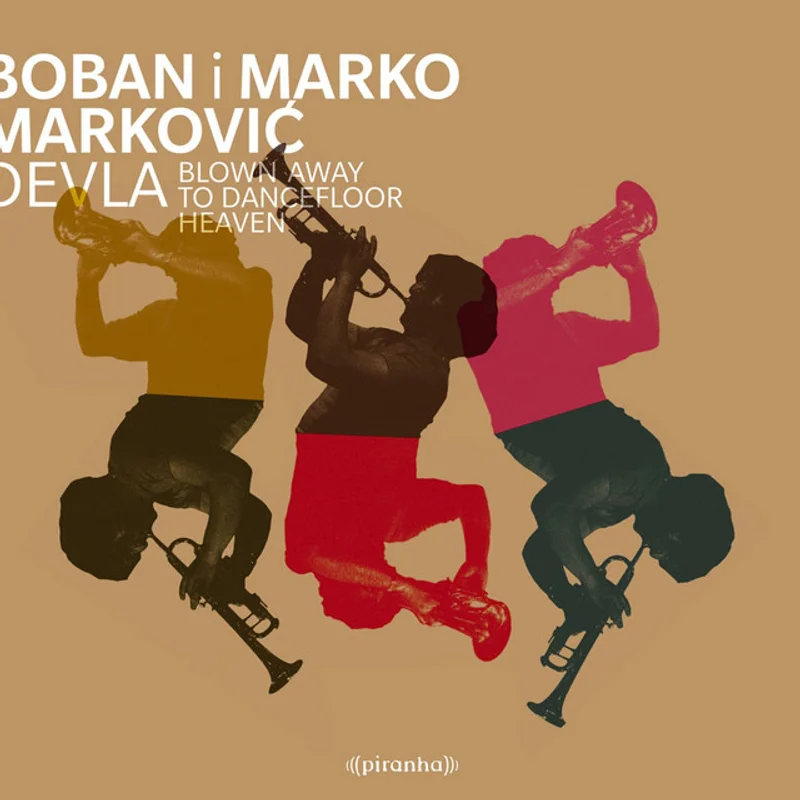
Devla
A Romani brass hurricane that splits the difference between ecstasy and melancholy.
“A Romani brass hurricane that splits the difference between ecstasy and melancholy.”
Somewhere in the flatlands of southern Serbia, in the town of Vladičin Han, the Marković family has been forging brass into gold for generations.
"Khelipe Cheasa" — Romani for something close to "Dance of the Home" or "The Household Dance" — emerged from the sessions that would become *Devla*, the album whose very title invokes God.
Boban Marković, the undisputed king of Balkan brass, had by this point begun sharing the spotlight with his prodigiously talented son Marko, and the track captures a dynasty in its most confident stride.
Recorded in the mid-2000s as the global appetite for Balkan brass was surging — stoked by Kusturica films, Bregović soundtracks, and the Guča Trumpet Festival's growing international fame — the piece arrived at the precise moment when the world was finally ready to hear what Serbian Roma had been playing at weddings and slava celebrations for centuries.
The sonic architecture of "Khelipe Cheasa" is deceptively sophisticated.
At 120 BPM it occupies a restrained middle ground for a genre that often accelerates into frenzied čoček territory, and that restraint is the secret to its hypnotic power.
Boban's flugelhorn — his instrument of choice over the brighter trumpet — leads with a tone that is round, burnished, almost vocal in its phrasing, while Marko's trumpet answers and embroiders with a younger, slightly sharper edge.
Beneath them, the tuba section lays down a walking bass pattern that functions like a heartbeat, and the snare and bass drum lock into an asymmetric groove rooted in Romani dance rhythms but subtly straightened for accessibility.
The key of C major gives the piece an open, unadorned brightness, yet the orkestar bends pitches and deploys modal inflections — touches of the Phrygian dominant scale — that lend the major tonality an unmistakable ache.
There is no studio trickery here: the production philosophy is essentially documentary, capturing a dozen men in a room breathing together.
Being a purely instrumental piece, "Khelipe Cheasa" tells its story without a single word, and that is precisely its eloquence.
The melodic arc functions as narrative: an opening statement that feels like an invocation, a middle passage where the brass voices converse and overlap in call-and-response, and a culminating section where the full ensemble locks into unison lines of devastating power.
The emotional trajectory moves from contemplation to communion — from a single voice calling out across a courtyard to an entire household rising to dance.
In the Romani tradition, instrumental music is never merely decorative; it carries the weight of occasions — births, weddings, feasts of patron saints — and "Khelipe Cheasa" channels that ceremonial gravity.
The energy rating of 0.50 and valence of 0.50 are telling: this is not simple joy, nor is it sorrow.
It lives in the liminal space the Roma call *dor* — a longing that is inseparable from celebration, a reminder that every dance is also a prayer.
By the time *Devla* reached international audiences, the Boban i Marko Marković Orkestar had already been crowned multiple winners at the Guča Trumpet Festival, the annual Serbian competition that draws hundreds of thousands of spectators.
The album was released on Piranha Musik, the Berlin-based world music label that had become a crucial bridge between Balkan brass and Western European listeners.
Critics hailed *Devla* as one of the finest Balkan brass recordings of its era, praising its balance of raw power and musical intelligence.
"Khelipe Cheasa" became a staple of the band's legendary live sets, where its moderate tempo served as a palate cleanser between the frenetic čočeks that left audiences breathless.
The track circulated through DJ sets in the burgeoning Balkan beats scene, championed by figures like Shantel and DJ Tagada, who recognized its groove potential beneath the acoustic surface.
The legacy of "Khelipe Cheasa" extends far beyond any single performance.
It stands as a testament to a musical tradition that has survived centuries of marginalization, persecution, and cultural erasure.
The Romani brass band tradition of southern Serbia — born from Ottoman military bands, filtered through generations of itinerant musicians, and refined at countless celebrations — finds in this track one of its most perfectly balanced expressions.
For the Marković dynasty, it represents the seamless passing of the torch from father to son, a continuity that is itself a form of resistance.
In the broader arc of world music, the track reminds us that some of the most sophisticated ensemble playing on the planet happens not in conservatories but in village squares, not through written scores but through an oral tradition so deep it might as well be encoded in DNA.
Every time the opening phrase of "Khelipe Cheasa" rings out — whether in a smoky Belgrade kafana, a festival field in Guča, or a club in Berlin — it carries with it the irreducible truth that brass, breath, and rhythm are enough to hold an entire world.