FirstWeTakeManhattan
Leonard Cohen
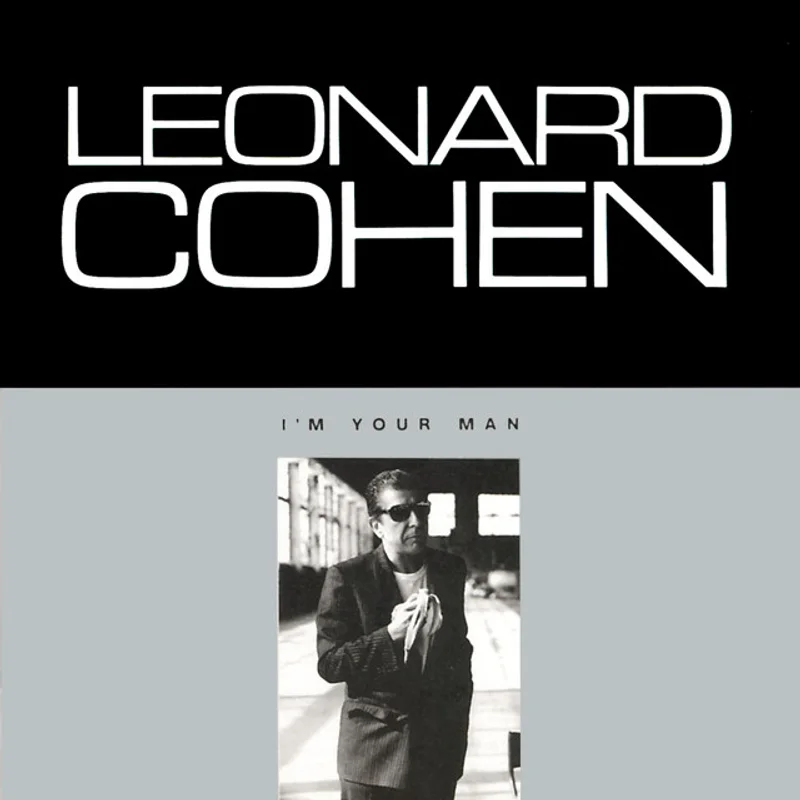
I'm Your Man
Leonard Cohen declares war on complacency with a synthesizer and a sinister grin.
💃🕺💃
They sentenced me to 20 years of boredom
For trying to change the system from within
I'm coming now, I'm coming to reward them
First we take Manhattan, then we take Berlin
I'm guided by a signal in the heavens (Guided, guided)
I'm guided by this birthmark on my skin (I am guided by)
I'm guided by the beauty of our weapons (Ooh, ooh)
First we take Manhattan, then we take Berlin
I'd really like to live beside you, baby
I love your body and your spirit and your clothes
But you see that line there moving through the station?
I told you, I told you, told you I was one of those
Ah, you loved me as a loser, but now you're worried that I just might win
You know the way to stop me, but you don't have the discipline
How many nights I prayed for this, to let my work begin
First we take Manhattan, then we take Berlin
I don't like your fashion business, mister
And I don't like these drugs that keep you thin
I don't like what happened to my sister
First we take Manhattan, then we take Berlin
I'd really like to live beside you, baby
I love your body and your spirit and your clothes
But you see that line there moving through the station?
I told you, I told you, told you I was one of those
And I thank you for those items that you sent me, ha ha ha ha
The monkey and the plywood violin
I practiced every night, now I'm ready
First we take Manhattan, then we take Berlin
I am guided
Ah, remember me, I used to live for music (Baby)
Remember me, I brought your groceries in (Ooh, baby, yeah)
Well, it's Father's Day, and everybody's wounded
First we take Manhattan, then we take Berlin
💃🕺💃
They sentenced me to 20 years of boredom
For trying to change the system from within
I'm coming now, I'm coming to reward them
First we take Manhattan, then we take Berlin
I'm guided by a signal in the heavens (Guided, guided)
I'm guided by this birthmark on my skin (I am guided by)
I'm guided by the beauty of our weapons (Ooh, ooh)
First we take Manhattan, then we take Berlin
I'd really like to live beside you, baby
I love your body and your spirit and your clothes
But you see that line there moving through the station?
I told you, I told you, told you I was one of those
Ah, you loved me as a loser, but now you're worried that I just might win
You know the way to stop me, but you don't have the discipline
How many nights I prayed for this, to let my work begin
First we take Manhattan, then we take Berlin
I don't like your fashion business, mister
And I don't like these drugs that keep you thin
I don't like what happened to my sister
First we take Manhattan, then we take Berlin
I'd really like to live beside you, baby
I love your body and your spirit and your clothes
But you see that line there moving through the station?
I told you, I told you, told you I was one of those
And I thank you for those items that you sent me, ha ha ha ha
The monkey and the plywood violin
I practiced every night, now I'm ready
First we take Manhattan, then we take Berlin
I am guided
Ah, remember me, I used to live for music (Baby)
Remember me, I brought your groceries in (Ooh, baby, yeah)
Well, it's Father's Day, and everybody's wounded
First we take Manhattan, then we take Berlin
“Leonard Cohen declares war on complacency with a synthesizer and a sinister grin.”
By the mid-1980s, Leonard Cohen was a man the music industry had largely written off.
His previous album, *Various Positions* (1984), had been famously rejected by Columbia Records' Walter Yetnikoff, who reportedly told Cohen, "We know you're great, Leonard, but we don't know if you're any good." It was a humiliation that might have broken a lesser artist.
Instead, Cohen retreated into a period of intense reinvention, spending years between Los Angeles, Montreal, and Europe, immersing himself in the possibilities of synthesizers and drum machines.
When he emerged in 1988 with *I'm Your Man*, he had shed his skin entirely.
"First We Take Manhattan" was the album's opening salvo — a declaration of intent so startling that it announced not merely a comeback, but a complete metamorphosis.
The song had been gestating for years; Cohen reportedly worked through nearly 200 drafts of the lyrics, honing each line with the obsessive precision of a diamond cutter.
The track was recorded with a team of collaborators at Studio Tempo in Montreal and later refined in Los Angeles, with production shared between Cohen and Roscoe Beck, his longtime musical director.
The sonic architecture of "First We Take Manhattan" is a masterclass in tension.
Built on a foundation of programmed Casio synthesizers and drum machines pulsing at a deliberate 110 BPM, the track inhabits a peculiar emotional no-man's-land — not quite menacing, not quite celebratory, but something unsettlingly in between.
The key of C major lends a deceptive brightness to what is essentially a march of conquest, while the energy remains restrained at a simmer rather than a boil.
Jennifer Warnes' backing vocals — ethereal, almost liturgical — float above the mechanical rhythm like incense over a battlefield.
The production choices were radical for Cohen: where once there had been acoustic guitar and spare arrangements, now there were layers of synthetic texture, sequenced bass lines, and a propulsive, almost industrial groove.
Yet Cohen's baritone — deeper and more weathered than ever — anchors the entire production in unmistakable humanity.
The contrast between the cold precision of the machines and the warm gravity of his voice is the song's secret weapon.
Lyrically, "First We Take Manhattan" operates on multiple planes of meaning simultaneously, and Cohen was characteristically elusive about pinning it to any single interpretation.
On one level, it is the manifesto of a terrorist or revolutionary — someone who has been "sentenced to twenty years of boredom for trying to change the system from within" and now plans an external assault.
On another, it is Cohen's own artistic revenge fantasy, the poet returning from exile to conquer the cultural capitals that had dismissed him.
Manhattan represents the commercial machinery of the American music industry; Berlin, the European intellectual establishment.
But the song's genius lies in how Cohen implicates himself and the listener in the seductiveness of extremism.
"I'm guided by the beauty of our weapons" is one of the most chilling and morally complex lines in popular music — a phrase that acknowledges how ideology, violence, and aesthetics can become fatally intertwined.
The personal verses — "I'd really like to live beside you, baby" — ground the grandiosity in intimate loss, suggesting that the narrator's crusade has cost him love and domesticity.
The "monkey and the plywood violin" become symbols of the cheap, inadequate tools given to artists, which through relentless practice become instruments of transformation.
The song's reception was nothing short of revelatory.
Released as the lead single from *I'm Your Man* in 1988, it signaled to critics and fans alike that Cohen had not merely survived the wilderness years but had returned with a terrifying new clarity.
Reviews were rapturous.
The album reached the top ten in numerous European countries, and "First We Take Manhattan" became a staple of Cohen's live performances for the rest of his career.
Jennifer Warnes had actually released her own version of the song a year earlier on her Cohen tribute album *Famous Blue Raincoat* (1987), which served as an unlikely advance herald of Cohen's reinvention.
The track resonated powerfully in the late Cold War context — Berlin was still a divided city when Cohen wrote it, and the song's imagery of conquest and ideological fervor carried an electric charge.
After the Berlin Wall fell in 1989, the song took on yet another layer of meaning, as if Cohen had prophesied the upheaval.
The legacy of "First We Take Manhattan" extends far beyond its chart performance or critical acclaim.
It fundamentally altered the perception of Leonard Cohen, transforming him from a figure of the folk past into a vital, contemporary voice.
The song's influence can be traced through the work of artists as diverse as Nick Cave, Depeche Mode, and Arctic Monkeys — musicians who understood that synthesizers and drum machines need not preclude depth, irony, or moral complexity.
The track has been covered by R.E.M., Joe Cocker, and dozens of others, each version revealing new facets of its inexhaustible lyric.
It has appeared in films, television series, and cultural commentary with striking regularity, its title phrase becoming shorthand for any audacious plan of conquest.
Perhaps most importantly, "First We Take Manhattan" demonstrated that an artist in his fifties could reinvent himself completely without sacrificing an ounce of integrity — that the late work could be not a diminishment but an apotheosis.
In the cathedral of Cohen's catalog, this track stands as the moment the congregation realized the sermon had only just begun.