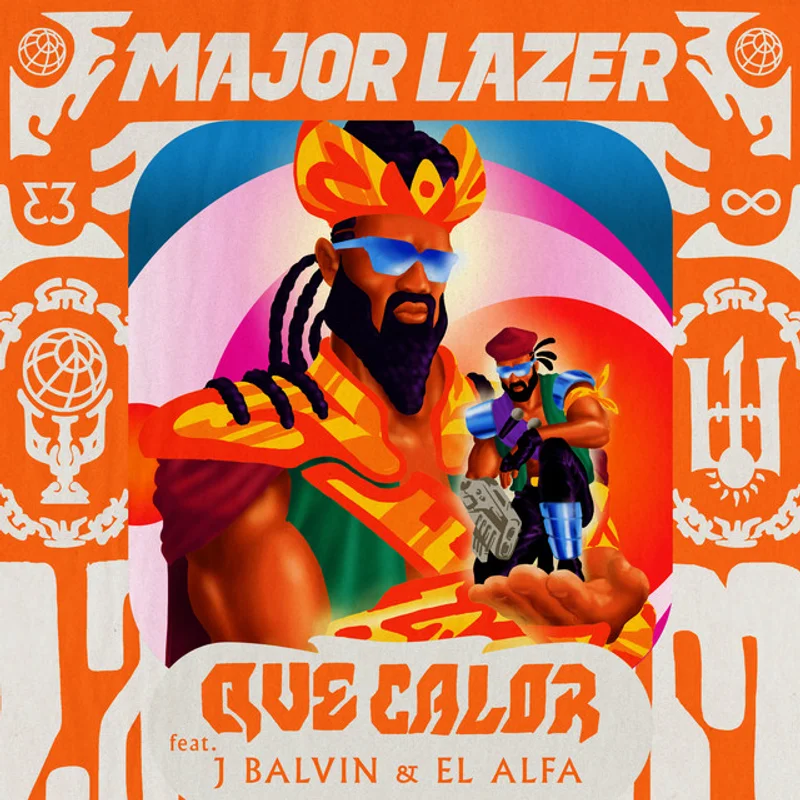
QueCalor(withJBalvin&ElAlfa)
Major Lazer, J Balvin, El Alfa, Diplo
Que Calor (with J Balvin & El Alfa)
A pan-Latin supernova that turned the dancefloor into a furnace of global unity.
Major Lazer
J Balvin, man
Latino Gang, wuh
Global
El Alfa
Yao'
Wuh, wuh
Qué ca'
¡Yesca!
Leggo'
Qué calor (Qué ca'), Qué ca' (Qué ca')
En la discoteca
Qué calor (Qué ca'), yesca (Qué ca')
Para las muñeca'
Por favor, qué ca' (Qué ca')
En la discoteca
Qué calor (Qué ca'), yesca (Qué ca')
Para las muñeca', por favor
Esa rubia no me entiende si yo le hablo en español (what?)
Pero se aprendió la canción a la perfección (Lo sabe)
Por mi patria, por mi nación, ninguna discriminación
Aquí no hay raza ni religión, báilalo por obligación
Qué calor (Qué ca', qué ca', qué ca')
Qué calor (Qué ca'-qué ca', qué ca')
Qué calor, Qué ca' en la discoteca
Qué calor, yesca para las muñeca'
(Por favor, por favor, wah, wah)
Las mujere' me la' como al vapor
En la playa bañado en sudor
Los bikini' te quedan mejor
Tú ere' mi amor, -mor, -mor, -mor
Cada vez que veo ese booty yo me quedo loco
Tú le da' hasta abajo, mami, con mucho saoco
Como tú lo mueve' en el mundo lo mueven poco
Dale, dale, baila a lo loco
Como tú lo mueve' en el mundo lo mueven poco
Dale, dale, baila a lo loco
Como tú lo mueve' en el mundo lo mueven poco
Calentamiento global (¡Wuh!)
Anda suelto el animal (Grr)
Mano arriba el que e' real (hah)
(Esto se va a hacer viral)
Qué calor, qué ca'
En la discoteca
Qué calor, yesca
Para las muñeca'
Por favor, qué ca'
En la discoteca
Qué calor, yesca
Para las muñeca', por favor
(Qué ca', qué ca', qué ca')
Qué calor (Qué ca'-qué ca', qué ca')
Qué calor, que ca'
En la discoteca
Qué calor, yesca
Para las muñeca', por favor
Qué calor (it's Colombia, it's not Columbia, alright?)
Por favor (Colombia, not Columbia)
Qué calor
Muevete, -te-te
(Cumbia) Mue-ve- (leggo')
-Te-te-te-te-te-te-te-te
-Te-te, te-que-te, -te-que-te-que, -te-que-te
-Te-te-te-te-te-te-te-te
-Te-te, te-que-te, -te-que-te-que, -te-que-te
-Te-te-te-te-te-te-te-te (Latino gang, latino gang)
-Te-te-te-te, -te-que-te-que, -te-que-te (Gang, gang, gang)
-Te-te-te-te-te-te-te-te (Latino gang, latino gang)
-Te-te-te-te, -te-que-te-que, -te-que-te (Latino gang)
Major Lazer
J Balvin, man
Latino Gang, wuh
Global
El Alfa
Yao'
Wuh, wuh
Qué ca'
¡Yesca!
Leggo'
Qué calor (Qué ca'), Qué ca' (Qué ca')
En la discoteca
Qué calor (Qué ca'), yesca (Qué ca')
Para las muñeca'
Por favor, qué ca' (Qué ca')
En la discoteca
Qué calor (Qué ca'), yesca (Qué ca')
Para las muñeca', por favor
Esa rubia no me entiende si yo le hablo en español (what?)
Pero se aprendió la canción a la perfección (Lo sabe)
Por mi patria, por mi nación, ninguna discriminación
Aquí no hay raza ni religión, báilalo por obligación
Qué calor (Qué ca', qué ca', qué ca')
Qué calor (Qué ca'-qué ca', qué ca')
Qué calor, Qué ca' en la discoteca
Qué calor, yesca para las muñeca'
(Por favor, por favor, wah, wah)
Las mujere' me la' como al vapor
En la playa bañado en sudor
Los bikini' te quedan mejor
Tú ere' mi amor, -mor, -mor, -mor
Cada vez que veo ese booty yo me quedo loco
Tú le da' hasta abajo, mami, con mucho saoco
Como tú lo mueve' en el mundo lo mueven poco
Dale, dale, baila a lo loco
Como tú lo mueve' en el mundo lo mueven poco
Dale, dale, baila a lo loco
Como tú lo mueve' en el mundo lo mueven poco
Calentamiento global (¡Wuh!)
Anda suelto el animal (Grr)
Mano arriba el que e' real (hah)
(Esto se va a hacer viral)
Qué calor, qué ca'
En la discoteca
Qué calor, yesca
Para las muñeca'
Por favor, qué ca'
En la discoteca
Qué calor, yesca
Para las muñeca', por favor
(Qué ca', qué ca', qué ca')
Qué calor (Qué ca'-qué ca', qué ca')
Qué calor, que ca'
En la discoteca
Qué calor, yesca
Para las muñeca', por favor
Qué calor (it's Colombia, it's not Columbia, alright?)
Por favor (Colombia, not Columbia)
Qué calor
Muevete, -te-te
(Cumbia) Mue-ve- (leggo')
-Te-te-te-te-te-te-te-te
-Te-te, te-que-te, -te-que-te-que, -te-que-te
-Te-te-te-te-te-te-te-te
-Te-te, te-que-te, -te-que-te-que, -te-que-te
-Te-te-te-te-te-te-te-te (Latino gang, latino gang)
-Te-te-te-te, -te-que-te-que, -te-que-te (Gang, gang, gang)
-Te-te-te-te-te-te-te-te (Latino gang, latino gang)
-Te-te-te-te, -te-que-te-que, -te-que-te (Latino gang)
“A pan-Latin supernova that turned the dancefloor into a furnace of global unity.”
By the summer of 2019, Diplo's Major Lazer project had already proven itself as one of the most restless and border-dissolving forces in popular music.
From the dancehall-inflected anthems of their early work to the global pop crossover of "Lean On," the collective had spent a decade acting as a sonic passport office — stamping visas between Kingston, Lagos, Mumbai, and Miami.
But "Que Calor" represented something different: a deliberate, joyful surrender to the gravitational pull of Latin music that had been reshaping the global pop landscape since the despacito earthquake of 2017.
Diplo had been spending increasing amounts of time in Medellín and Santo Domingo, absorbing the rhythmic vocabularies of reggaetón, dembow, and cumbia firsthand.
When he linked with Colombian superstar J Balvin — already the reigning prince of urbano — and Dominican dembow titan El Alfa, the chemistry was immediate and combustible.
The track was forged across multiple sessions spanning Miami's Hit Factory, studios in Medellín, and remote file exchanges, a production process as geographically scattered as the song's DNA.
The sonic architecture of "Que Calor" is a masterclass in controlled chaos.
Locked at 128 BPM — a tempo that splits the difference between house music's pulse and reggaetón's bounce — the track opens with stacked vocal tags and ad-libs that function almost like a roll call, a summoning ritual for the dancefloor.
The production, helmed by Diplo alongside his frequent collaborator Ape Drums, layers a dembow-inflected riddim beneath shimmering cumbia-style accordion stabs and a bassline that hits like a heat wave rolling off asphalt.
The key of C major lends the track an open, almost innocent brightness that belies the sheer physical intensity of its low end.
Listen closely and you'll hear the ghost of Dominican dembow — that galloping, asymmetrical kick pattern that El Alfa rides like a rodeo champion — woven into a framework sturdy enough for festival main stages.
The outro, with its stuttering "te-te-te-te" vocal chop, dissolves the song into pure percussive abstraction, a nod to the cumbia rebajada tradition of slowing and deconstructing rhythms until they become hypnotic.
Lyrically, "Que Calor" operates on the principle that heat is both literal and metaphorical — a temperature, a feeling, a state of being.
The title phrase, repeated like an incantation, transforms from a simple weather report into a declaration of erotic energy and communal euphoria.
J Balvin's verse is characteristically smooth and slyly political: "Esa rubia no me entiende si yo le hablo en español, pero se aprendió la canción a la perfección" — a blonde woman who doesn't understand his Spanish but has learned every word of the song.
It's a quietly triumphant observation about the way Latin music had conquered ears that couldn't parse a single lyric.
His follow-up — "por mi patria, por mi nación, ninguna discriminación, aquí no hay raza ni religión" — elevates the dancefloor into a utopian space where identity collapses into rhythm.
El Alfa, meanwhile, brings the raw, unfiltered energy of Santo Domingo's streets, his rapid-fire dembow flow celebrating bodies, beaches, and the kind of movement that defies imitation: "Como tú lo mueve' en el mundo lo mueven poco." The cheeky aside — "It's Colombia, it's not Columbia, alright?" — is J Balvin at his most playfully corrective, turning a pet peeve into a viral moment.
The cultural timing of "Que Calor" was impeccable.
Released in September 2019, it arrived at the zenith of Latin music's streaming-era dominance, a moment when Bad Bunny, Rosalía, and Balvin himself were redrawing the map of global pop.
The track debuted on the Billboard Hot 100 and climbed into the top ten of Hot Latin Songs, while its Aye Hasselmann-directed music video — a sun-drenched fever dream shot in the Sahara Desert — racked up hundreds of millions of YouTube views.
Critics praised it as one of Major Lazer's most cohesive fusions, a track that didn't simply borrow from Latin genres but genuinely inhabited them.
The song became a staple of festival sets from Coachella to Tomorrowland, its chorus functioning as a universal call-and-response that needed no translation.
A remix featuring Diplo's own cumbia-heavy rework extended its lifespan well into 2020.
The legacy of "Que Calor" extends beyond its chart performance.
It stands as a pivotal document of the moment when the global music industry fully acknowledged that the future of pop was multilingual, polyrhythmic, and unapologetically rooted in the Global South.
For Major Lazer, it was proof of concept for their final album cycle — a demonstration that their genre-agnostic philosophy could thrive in the era of urbano dominance without resorting to tourism or tokenism.
For J Balvin, it reinforced his position as reggaetón's most cosmopolitan ambassador, equally at home on a Diplo beat as on a traditional Colombian stage.
And for El Alfa, it was a coronation — the moment dembow, long the scrappy underdog of Caribbean music, stood shoulder to shoulder with the biggest names in global pop.
"Que Calor" remains a reminder that the dancefloor, at its best, is the most democratic space on earth: a place where language dissolves, borders evaporate, and the only passport required is the willingness to move.