PokémonTheme
Pokémon
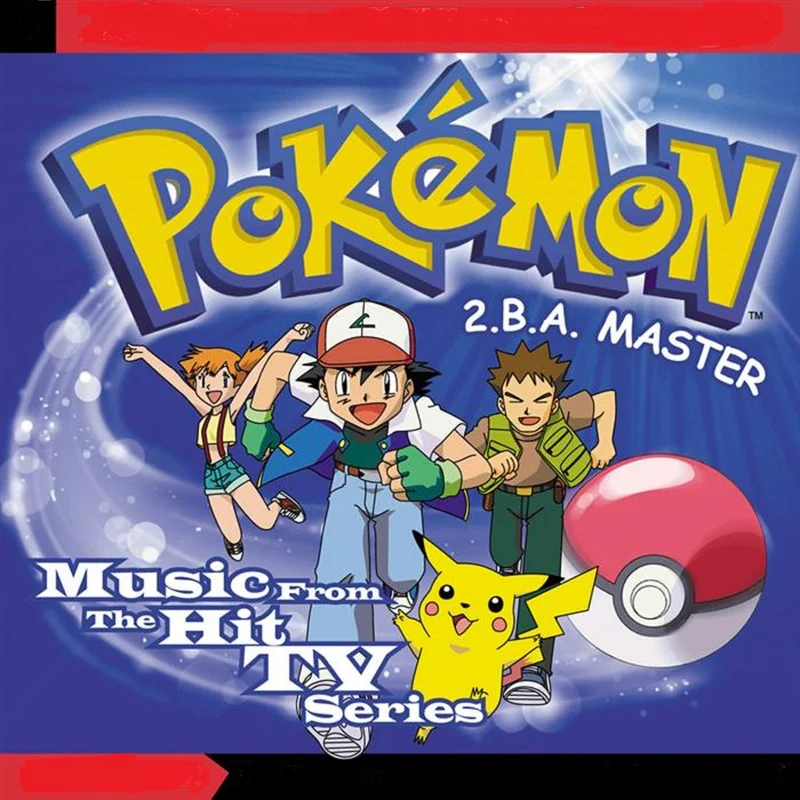
Pokémon: 2.B.A. Master (Music from the TV Series)
The battle cry of a generation, forged in A minor and destined to echo forever.
I wanna be the very best
Like no one ever was
To catch them is my real test
To train them is my cause
I will travel across the land
Searching far and wide
Teach Pokémon to understand
The power that's inside
Pokémon (gotta catch 'em all), it's you and me
I know it's my destiny (Pokémon)
Oh, you're my best friend
In a world we must defend
Pokémon (gotta catch 'em all), a heart so true
Our courage will pull us through
You teach me and I'll teach you
Pokémon (gotta catch 'em all)
Gotta catch 'em all, yeah
Every challenge along the way
With courage I will face
I will battle every day
To claim my rightful place
Come with me, the time is right
There's no better team
Arm in arm, we'll win the fight
It's always been our dream
Pokémon (gotta catch 'em all), it's you and me
I know it's my destiny (Pokémon)
Oh, you're my best friend
In a world we must defend
Pokémon (gotta catch 'em all), a heart so true
Our courage will pull us through
You teach me and I'll teach you
Pokémon (gotta catch 'em all)
Gotta catch 'em all
Gotta catch 'em all
Gotta catch 'em all
Gotta catch 'em all
Yeah
Pokémon (gotta catch 'em all), it's you and me
I know it's my destiny (Pokémon)
Oh, you're my best friend
In a world we must defend
Pokémon (gotta catch 'em all), a heart so true
Our courage will pull us through
You teach me and I'll teach you
Pokémon (gotta catch 'em all)
Gotta catch 'em all, Pokémon
I wanna be the very best
Like no one ever was
To catch them is my real test
To train them is my cause
I will travel across the land
Searching far and wide
Teach Pokémon to understand
The power that's inside
Pokémon (gotta catch 'em all), it's you and me
I know it's my destiny (Pokémon)
Oh, you're my best friend
In a world we must defend
Pokémon (gotta catch 'em all), a heart so true
Our courage will pull us through
You teach me and I'll teach you
Pokémon (gotta catch 'em all)
Gotta catch 'em all, yeah
Every challenge along the way
With courage I will face
I will battle every day
To claim my rightful place
Come with me, the time is right
There's no better team
Arm in arm, we'll win the fight
It's always been our dream
Pokémon (gotta catch 'em all), it's you and me
I know it's my destiny (Pokémon)
Oh, you're my best friend
In a world we must defend
Pokémon (gotta catch 'em all), a heart so true
Our courage will pull us through
You teach me and I'll teach you
Pokémon (gotta catch 'em all)
Gotta catch 'em all
Gotta catch 'em all
Gotta catch 'em all
Gotta catch 'em all
Yeah
Pokémon (gotta catch 'em all), it's you and me
I know it's my destiny (Pokémon)
Oh, you're my best friend
In a world we must defend
Pokémon (gotta catch 'em all), a heart so true
Our courage will pull us through
You teach me and I'll teach you
Pokémon (gotta catch 'em all)
Gotta catch 'em all, Pokémon
“The battle cry of a generation, forged in A minor and destined to echo forever.”
In the summer of 1998, as a tidal wave of pocket monsters swept westward from Japan, a songwriter named John Siegler and a producer named John Loeffler sat in a New York studio tasked with an almost impossible brief: distill an entire cultural phenomenon into a ninety-second television opening.
Working under the auspices of 4Kids Entertainment, the duo had to capture the spirit of a franchise that was already a religion in Japan — the Game Boy cartridges, the trading cards, the anime — and translate it into something that American children would absorb into their very bloodstreams.
What emerged was not merely a theme song but an anthem, a piece of music so precisely engineered for emotional imprinting that it would become, for millions, the first song they ever truly loved.
Loeffler, a veteran jingle writer and children's music composer, understood that the track needed the gravitational pull of a pop hit but the narrative clarity of a story.
He and Siegler wrote quickly, almost feverishly, aware that the American launch of the Pokémon anime was barreling toward them on a fixed deadline.
The sonic architecture of the Pokémon Theme is a masterclass in controlled energy disguised as simplicity.
Anchored in A minor at a deceptively moderate 90 BPM, the track pulses with a tension that belies its reputation as mere kids' fare.
The production leans on crunchy, palm-muted electric guitars that chug beneath the verses, evoking the power-pop and arena-rock idioms of the late nineties — think Lit or Smash Mouth filtered through a Saturday morning sensibility.
Layered synthesizer pads provide a cinematic wash, while a punchy programmed drum kit locks the groove into something both marching and danceable.
The chorus explodes with stacked vocal harmonies and a call-and-response structure — the parenthetical "gotta catch 'em all" functioning almost as a Greek chorus — that transforms passive listening into active participation.
Singer Jason Paige, a seasoned session vocalist, delivered the lead with a raspy, full-throated conviction that treated the material not as a novelty but as a genuine rock performance, lending the track a credibility that would prove essential to its longevity.
Lyrically, the song operates on a dual register that explains its remarkable staying power.
On the surface, it is a mission statement for Ash Ketchum, the anime's protagonist, setting out from Pallet Town to become a Pokémon Master.
But beneath that narrative scaffolding lies a universal parable of ambition, friendship, and mutual growth.
"I wanna be the very best / Like no one ever was" is as potent a declaration of aspiration as anything in the rock canon — stripped of irony, unashamed in its earnestness.
The verses chart a hero's journey — travel, challenge, battle, destiny — while the chorus pivots to something more intimate and reciprocal: "You teach me and I'll teach you." This single line elevates the entire enterprise, reframing the relationship between trainer and Pokémon (and, by extension, between child and world) as one of mutual education rather than domination.
The emotional arc moves from solitary ambition to communal purpose, from "I" to "we," mapping the very developmental trajectory of its young audience.
The key of A minor lends the melody a bittersweet, striving quality — not quite triumphant, always reaching — that gives the song an undertow of genuine feeling beneath its bright surface.
The cultural impact was immediate and staggering.
When the Pokémon anime debuted on American television on September 8, 1998, the theme song became the spearhead of what media analysts would call "Pokémania." The companion album, "2.B.A.
Master," released in November 1999, debuted at number thirty-three on the Billboard 200 and was certified Gold by the RIAA, a remarkable feat for a children's television soundtrack.
The theme itself charted in multiple countries, reaching the top ten in the UK, France, and Germany.
Critics who might have dismissed it as a merchandising jingle found themselves grudgingly acknowledging its craftsmanship.
More importantly, the song became a shared cultural text for an entire generation — chanted on playgrounds, performed at talent shows, memorized before children could read the lyrics.
It transcended its commercial origins to become something closer to folk music, passed from child to child like a secret handshake.
A quarter century later, the Pokémon Theme endures as one of the most recognizable pieces of music on Earth, a distinction it shares with vanishingly few compositions from any genre.
It has been covered, remixed, memed, performed by symphony orchestras, screamed at karaoke bars, and sung at weddings — always with an intensity that suggests something deeper than nostalgia.
Jason Paige has become a beloved figure on social media, performing the song with the same full-bodied commitment he brought to the original session, his videos routinely amassing millions of views.
The track's legacy extends beyond the Pokémon franchise; it helped establish the template for how anime and gaming properties would be localized for Western audiences, proving that a well-crafted original theme could become as iconic as the source material itself.
In the broader history of popular music, it stands as a testament to the power of sincerity — a song that refused to condescend to its audience and was rewarded with a devotion that has outlasted nearly every cynical calculation of the era that produced it.
To press play on this track is to be ten years old again, standing at the edge of a vast and unmapped world, believing with absolute certainty that you were born to conquer it — and that you wouldn't have to do it alone.