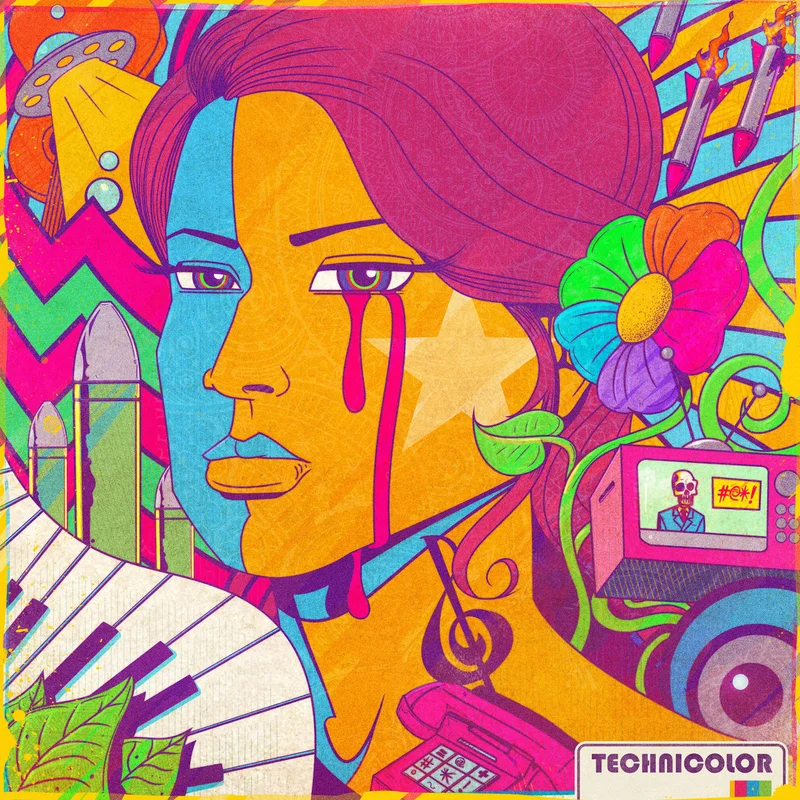
Technicolor
Sweet Lizzy Project
Technicolor
A kaleidoscopic anthem that transforms the ache of numbness into a riot of living color.
Look at me I'm blurry
The world is not black or white
Staring at these colors
Eventually, my eyes will dry
I'm colorblind
I wish that I could shine
I'm colorblind
I wish that I could shine
Weird shades have come in town
Appliances will let us down
Like a dream I'm falling
In Alice's hole underground
I'm colorblind
I wish that I could shine
I'm colorblind
I wish that I could shine
Technicolor
Start it up, start it up
Dye it all with colors
Technicolor
Start it up, start it up
Dye it all with colors
Technicolor
Start it up, start it up
Dye it all with colors
Technicolor
Start it up, start it up
Dye it all, dye it all
Technicolor
Start it up, start it up
Dye it all with colors
Technicolor
Start it up, start it up
Dye it all with colors
Technicolor
Start it up, start it up
Dye it all with colors
Technicolor
Start it up, start it up
Dye it all, dye it all
Look at me I'm blurry
The world is not black or white
Staring at these colors
Eventually, my eyes will dry
I'm colorblind
I wish that I could shine
I'm colorblind
I wish that I could shine
Weird shades have come in town
Appliances will let us down
Like a dream I'm falling
In Alice's hole underground
I'm colorblind
I wish that I could shine
I'm colorblind
I wish that I could shine
Technicolor
Start it up, start it up
Dye it all with colors
Technicolor
Start it up, start it up
Dye it all with colors
Technicolor
Start it up, start it up
Dye it all with colors
Technicolor
Start it up, start it up
Dye it all, dye it all
Technicolor
Start it up, start it up
Dye it all with colors
Technicolor
Start it up, start it up
Dye it all with colors
Technicolor
Start it up, start it up
Dye it all with colors
Technicolor
Start it up, start it up
Dye it all, dye it all
“A kaleidoscopic anthem that transforms the ache of numbness into a riot of living color.”
Sweet Lizzy Project emerged from the vibrant yet often overlooked musical crucible of Havana, Cuba — a collective of classically trained musicians who dared to fuse Latin rhythms, indie pop sensibilities, and electronic textures into something genuinely borderless.
"Technicolor," the title track of their breakthrough album, was born during a period of intense personal and creative transformation for the group.
Lead vocalist Lisset Díaz and her collaborators found themselves navigating the disorienting space between cultures, between the monochrome constraints of expectation and the prismatic possibilities of artistic freedom.
The song crystallized during late-night sessions where the band wrestled with feelings of invisibility — of being "blurry" in a world that demanded sharp, easily categorized identities.
Musically, "Technicolor" is a masterclass in restrained tension and euphoric release.
Sitting at a steady 120 BPM in the bright, unadorned key of C major, the production occupies a fascinating middle ground — its energy and valence both hovering at a contemplative midpoint, neither melancholic nor ecstatic, but rather balanced on a knife's edge between the two.
The verses unfold with a hushed, almost spectral quality: muted synth pads, delicate guitar arpeggios, and Díaz's voice floating in a reverb-kissed haze that sonically mirrors the "blurry" state described in the lyrics.
The arrangement is deliberately sparse in its opening movements, creating a sense of emotional claustrophobia that makes the chorus's eventual bloom feel like stepping from a darkened theater into blazing daylight.
The lyrical architecture of "Technicolor" traces a profound emotional arc from paralysis to agency.
The opening confession — "Look at me I'm blurry / The world is not black or white" — establishes a narrator caught in perceptual limbo, unable to process the complexity around her.
The metaphor of colorblindness operates on multiple registers: it speaks to emotional numbness, to the failure of binary thinking, and to the quiet desperation of feeling unseen.
The Alice in Wonderland reference — "In Alice's hole underground" — deepens the surrealist texture, casting the narrator's journey as a tumble into the subconscious, where familiar "appliances" (the tools and systems we rely on) prove useless.
Yet the song refuses to remain in that rabbit hole.
The chorus erupts as a declaration of self-determination: "Start it up, start it up / Dye it all with colors." It is not a passive wish but an imperative, a command to saturate one's own existence with meaning and vibrancy.
Upon its release, "Technicolor" resonated far beyond the band's Cuban origins, finding audiences across Latin America, Europe, and the indie blogosphere.
The track became something of a calling card for Sweet Lizzy Project's genre-defying approach, earning praise from critics who lauded its ability to communicate universal emotional truths through a sonic language that felt genuinely novel.
The song's placement in international music festivals and curated playlists helped position the group as ambassadors of a new wave of Cuban music — one that honored the island's rich musical heritage while fearlessly engaging with global pop, electronic, and alternative traditions.
In a cultural moment hungry for authenticity and cross-pollination, "Technicolor" arrived as proof that the most compelling art often emerges from the spaces between categories.
Years after its initial release, "Technicolor" endures as both a personal anthem for anyone who has felt flattened by the world's insistence on simplicity and a broader artistic statement about the power of creative reinvention.
Within Sweet Lizzy Project's catalog, it stands as the definitive thesis statement — the song that most fully embodies their belief that music should be a vehicle for transformation, not mere decoration.
Its legacy lives in the countless listeners who discovered that their own colorblindness was not a permanent condition but a starting point, and in the artists from Havana to Helsinki who heard in its grooves permission to be unclassifiable.
To press play on "Technicolor" is to be reminded that the world's palette is infinite — if only we have the courage to start it up and dye it all.