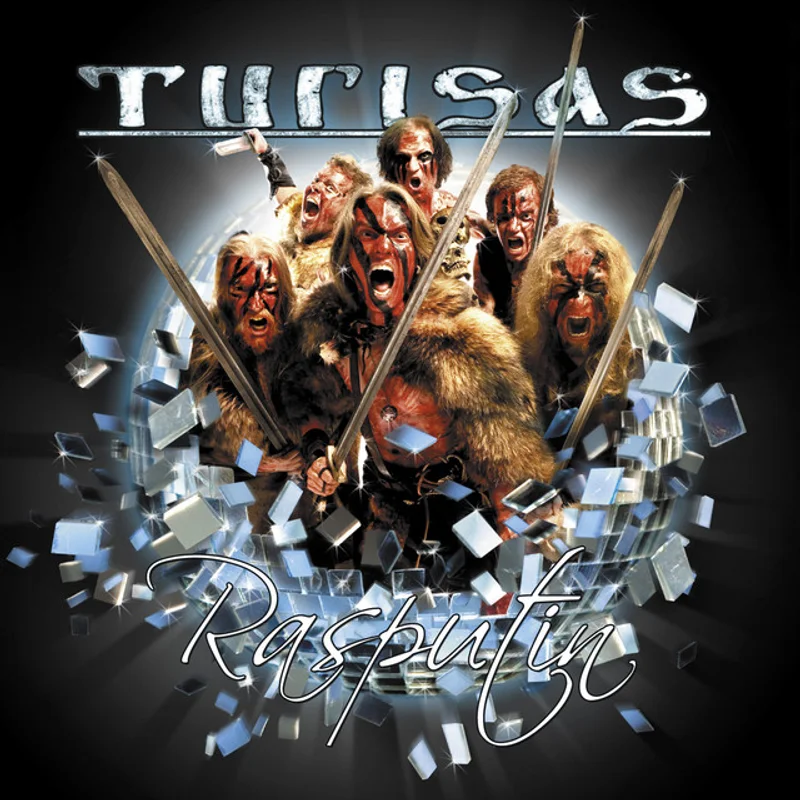
Rasputin
Turisas
Rasputin
A Finnish metal battalion storms the disco to resurrect history's most infamous mystic.
There lived a certain man in Russia long ago
He was big and strong, in his eyes a flaming glow
Most people looked at him with terror and with fear
And to Moscow chicks, he was such a lovely dear
He could preach the bible like a preacher, full of ecstasy and fire
But he also was the kind of teacher women would desire
Ra Ra Rasputin
Lover of the Russian queen
There was a cat that really was gone
Ra Ra Rasputin
Russia's greatest love machine
It was a shame how he carried on
He ruled the Russian land and never mind the tsar
But the kasachok he danced really wunderbar
In all affairs of state, he was the man to please
But he was real great when he had a girl to squeeze
For the queen he was no wheeler dealer
Though she'd heard the things he'd done
She believed he was a holy healer who would heal her son
Ra Ra Rasputin
Lover of the Russian queen
There was a cat that really was gone
Ra Ra Rasputin
Russia's greatest love machine
It was a shame how he carried on
But when he's drinking and lusting and hunger for power
Become known to more and more people
Their demands to do something about this outrageous man
Grew louder and louder
Hey, hey!
This man's just got to go, declared his enemies
But the ladies begged, don't you try to do it, please
No doubt this Rasputin had lots of hidden charms
Though he was a brute they just fell into his arms
Then one night some men of higher standing
Set a trap, they're not to blame
Come to visit us, they kept demanding
And he really came
Ra Ra Rasputin
Lover of the Russian queen
They put some poison into his wine
Ra Ra Rasputin
Russia's greatest love machine
He drank it all, and he said, I feel fine
Ra Ra Rasputin
Lover of the Russian queen
They didn't quit, they wanted his head
Ra Ra Rasputin
Russia's greatest love machine
And so they shot him 'til he was dead
Oh, those Russians
There lived a certain man in Russia long ago
He was big and strong, in his eyes a flaming glow
Most people looked at him with terror and with fear
And to Moscow chicks, he was such a lovely dear
He could preach the bible like a preacher, full of ecstasy and fire
But he also was the kind of teacher women would desire
Ra Ra Rasputin
Lover of the Russian queen
There was a cat that really was gone
Ra Ra Rasputin
Russia's greatest love machine
It was a shame how he carried on
He ruled the Russian land and never mind the tsar
But the kasachok he danced really wunderbar
In all affairs of state, he was the man to please
But he was real great when he had a girl to squeeze
For the queen he was no wheeler dealer
Though she'd heard the things he'd done
She believed he was a holy healer who would heal her son
Ra Ra Rasputin
Lover of the Russian queen
There was a cat that really was gone
Ra Ra Rasputin
Russia's greatest love machine
It was a shame how he carried on
But when he's drinking and lusting and hunger for power
Become known to more and more people
Their demands to do something about this outrageous man
Grew louder and louder
Hey, hey!
This man's just got to go, declared his enemies
But the ladies begged, don't you try to do it, please
No doubt this Rasputin had lots of hidden charms
Though he was a brute they just fell into his arms
Then one night some men of higher standing
Set a trap, they're not to blame
Come to visit us, they kept demanding
And he really came
Ra Ra Rasputin
Lover of the Russian queen
They put some poison into his wine
Ra Ra Rasputin
Russia's greatest love machine
He drank it all, and he said, I feel fine
Ra Ra Rasputin
Lover of the Russian queen
They didn't quit, they wanted his head
Ra Ra Rasputin
Russia's greatest love machine
And so they shot him 'til he was dead
Oh, those Russians
“A Finnish metal battalion storms the disco to resurrect history's most infamous mystic.”
Before Turisas unleashed their thunderous interpretation of "Rasputin" upon the world, the song already possessed a storied lineage stretching back to 1978, when Frank Farian's studio creation Boney M.
transformed the lurid biography of Grigori Yefimovich Rasputin into one of the most irresistible Euro-disco anthems ever pressed to vinyl.
Written by Farian himself, the original was a masterclass in making the macabre danceable.
But it took a Finnish battle metal band — face-painted, sword-wielding, and steeped in the bombastic traditions of folk metal — to recognize that the song's DNA was never purely disco.
Beneath the four-on-the-floor pulse lurked something darker, something operatic, something that demanded distorted guitars and the roar of a Viking warband.
Turisas recorded their cover as a standalone single in 2007, channeling the same audacious energy that defined their sophomore album "The Varangian Way," a concept record about Norse warriors traveling to Constantinople.
For a band obsessed with the collision between Northern Europe and the Byzantine East, Rasputin — the Siberian peasant who infiltrated the Romanov court — was a kindred spirit of sorts: an outsider who bent an empire to his will.
The production is a glorious act of alchemical transformation.
Where Boney M.
built their version on lush strings, handclaps, and Bobby Farrell's theatrical stage presence, Turisas constructs a sonic fortress in D minor at 133 BPM — a tempo that splits the difference between a march and a mosh pit.
The arrangement opens with an accordion flourish that nods to Eastern European folk tradition before detonating into a wall of distorted guitars, thundering double-bass drums, and layered choral vocals that evoke both a cathedral choir and a drunken tavern singalong.
The accordion and violin — signature instruments of Turisas's folk metal identity — weave throughout the track, providing melodic counterpoint to the crushing rhythm section.
The energy rating of 0.91 is immediately apparent: this is a track engineered for maximum physical impact, every bar designed to make a festival crowd of thousands move as one organism.
Yet the valence of 0.36 tells a subtler story — beneath the euphoria lies a minor-key melancholy, a recognition that this tale of seduction and power ends, as it must, in poison and bullets.
Lyrically, the song is a masterpiece of narrative economy, compressing the entire Rasputin saga into a handful of vivid verses.
The opening stanza establishes the contradiction at the heart of the man: "big and strong" with "eyes a flaming glow," he is simultaneously an object of terror and desire.
The lyrics dance between admiration and horror with a winking theatricality — "he could preach the bible like a preacher, full of ecstasy and fire" collapses the sacred and the profane into a single image.
The word "kasachok" (the Cossack dance) and "wunderbar" inject a playful multilingual absurdity that keeps the tone from ever becoming ponderous.
The chorus, with its iconic "Ra Ra Rasputin" chant, functions as both a celebration and a funeral march, its repetition mirroring the way Rasputin's legend grew through endless retelling.
The final verses chronicle his assassination with darkly comic understatement — poison, then bullets — and the closing exclamation "Oh, those Russians" is delivered with a shrug that encompasses centuries of bewildered Western fascination with Russian excess.
The cover's reception was nothing short of extraordinary, though its trajectory was unconventional.
Initially released to moderate fanfare within the metal community, the track found its true audience in the digital age.
It became a viral sensation on early YouTube, where its combination of absurd historical subject matter, infectious melody, and the inherent comedy of face-painted metalheads performing a disco classic proved irresistible.
The track introduced Turisas to audiences who would never have encountered Finnish folk metal otherwise, functioning as a gateway drug to an entire subgenre.
Within the metal world, the cover was embraced as a triumphant demonstration that genre boundaries are artificial constructs — that a song born in a Munich disco studio could be reborn in a Helsinki metal forge without losing an ounce of its essential vitality.
The track later experienced a massive second viral wave on TikTok in the early 2020s, proving that its appeal transcends not just genre but generation.
The legacy of Turisas's "Rasputin" extends far beyond its status as a beloved cover.
It stands as one of the definitive examples of cross-genre reinterpretation in heavy music, a proof of concept that metal's maximalist tendencies — the volume, the theatricality, the sheer physical force — can illuminate hidden dimensions in songs from entirely different traditions.
It demonstrated that folk metal, often dismissed as a novelty subgenre, possessed genuine interpretive power.
For Turisas themselves, the track remains their most widely known recording, a double-edged sword for a band with ambitious original material, but also an undeniable testament to their charisma and musicianship.
In the broader sweep of music history, it occupies a rare position: a cover that neither replaces nor diminishes the original but instead creates a parallel universe where the same story is told with different instruments and the same irrepressible joy.
Every time a festival crowd raises their fists and bellows "Ra Ra Rasputin" to a wall of distorted guitars, they are participating in a tradition that stretches from the salons of St.
Petersburg to the disco floors of the 1970s to the muddy fields of Wacken — proof that a great song, like its subject, simply refuses to die.