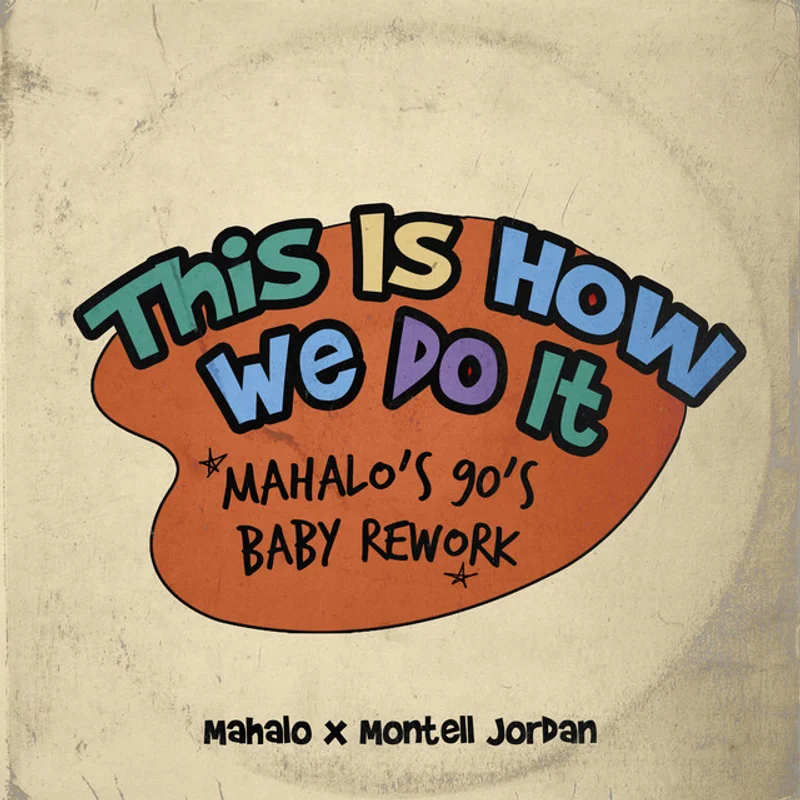
ThisIsHowWeDoIt-Mahalo’s90’sBabyRework
Montell Jordan, Mahalo
This Is How We Do It (Mahalo’s 90’s Baby Rework)
A '90s anthem reborn in neon light, pulsing between nostalgia and the eternal dancefloor.
“A '90s anthem reborn in neon light, pulsing between nostalgia and the eternal dancefloor.”
In the mid-1990s, Montell Jordan crafted what would become one of the most indelible party anthems of a generation.
"This Is How We Do It" was a distillation of South Central Los Angeles joy — a celebration of Friday nights, community, and the irrepressible urge to move.
Decades later, Los Angeles-based producer Mahalo — born Sahil Dua — reached back through time to resurrect that euphoria, filtering it through the prism of modern electronic production sensibilities.
His "90's Baby Rework" is not merely a remix; it is an act of temporal alchemy, a bridge between the carefree exuberance of '90s R&B and the polished, four-on-the-floor pulse of contemporary house music.
Stripped of its original vocal narrative, Mahalo's rework is a purely instrumental meditation — a fascinating creative decision that transforms the track from a lyrical celebration into an atmospheric experience.
The production sits at a deliberate 120 BPM, the canonical tempo of house music, and is cast in the bright, open tonality of C major.
Yet the energy and valence both hover at a measured midpoint, suggesting that Mahalo was reaching for something more nuanced than a simple peak-time banger.
There is a restraint here, a contemplative warmth that lets the listener fill in the emotional blanks with their own memories of the original.
The sonic palette is a masterclass in textural balance.
Mahalo layers filtered chords that echo the original's melodic DNA — themselves famously derived from Slick Rick's "Children's Story" — over crisp, modernized drum programming.
Shimmering hi-hats, deep sub-bass pulses, and strategically placed risers create a sense of perpetual anticipation.
Synth stabs reminiscent of the original's horn-like hooks appear and disappear like ghosts, just familiar enough to trigger recognition, just altered enough to feel entirely new.
The arrangement breathes with a DJ's intuition, building and releasing tension in waves designed for the dancefloor.
Without lyrics, the rework invites a different kind of emotional engagement.
Where Montell Jordan's original told a specific story — the Friday night ritual, the party on the Southside — Mahalo's version becomes a universal vessel for nostalgia itself.
The melodic fragments that surface throughout the track function as Proustian triggers, summoning not just the memory of a song but the entire sensory world of the 1990s: the warmth of a boombox, the glow of a house party, the feeling of being young and untethered.
It is instrumental music that somehow still tells a story, one written in the listener's own autobiography.
The cultural context of this rework is inseparable from the broader wave of '90s nostalgia that has swept through electronic music in the 2010s and 2020s.
Producers like Mahalo recognized that a generation raised on R&B and hip-hop had grown into festival-going, club-dwelling adults hungry for sounds that honored their roots while propelling them forward.
The rework found its natural habitat in sunset sets at pool parties, transitional moments in DJ sets, and curated playlists designed to evoke wistful celebration.
It circulated through SoundCloud, Spotify, and the informal economies of DJ culture, accruing millions of streams and becoming a staple in the libraries of tastemaking selectors.
Mahalo's rework also speaks to the evolving nature of authorship and collaboration in the streaming age.
By building upon Montell Jordan's iconic foundation — itself built upon Slick Rick's — the track becomes a palimpsest of Black musical innovation, each layer adding meaning without erasing what came before.
It stands as a testament to the idea that great songs are not fixed artifacts but living organisms, capable of regeneration and reinterpretation across decades and genres.
Ultimately, the "90's Baby Rework" endures because it captures something ineffable: the bittersweet joy of remembering a feeling you can never quite return to, rendered in four-on-the-floor kicks and shimmering synths.
It occupies a singular place in both Montell Jordan's extended catalog and Mahalo's growing body of work — proof that the best remixes don't just revisit the past but create an entirely new emotional space where past and present coexist on the dancefloor.