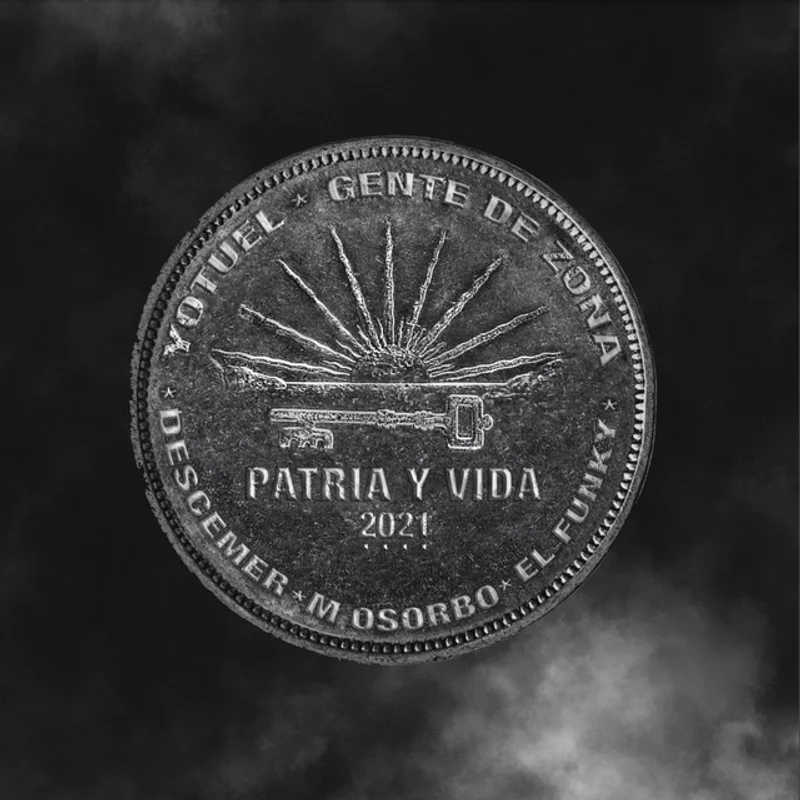
PatriayVida
Yotuel, Gente De Zona, Descemer Bueno, Maykel Osorbo, El Funky
Patria y Vida
A nation's cry reborn: Cuba's anthem of defiance flips a revolutionary slogan on its head.
Y eres tú mi canto de sirena
Porque con tu voz se van mis penas
Y este sentimiento ya está añejo
Tú me dueles tanto aunque estés lejos
Hoy yo te invito a caminar por mis solares
Pa' demostrarte de qué sirven tus ideales
Somos humanos aunque no pensemo' iguales
No nos tratemos ni dañemos como animales
Esta es mi forma de decírtelo
Llora mi pueblo y siento yo su voz
Tú cinco nueve, yo doble dos
Sesenta años trancado el dominó, ah
Bombo' y platillo' a los quinientos de La Habana
Mientras en casa las cazuelas ya no tienen jama
¿Qué celebramos si la gente anda deprisa?
Cambiando a Che Guevara y a Martí por la divisa
Todo ha cambiado, ya no es lo mismo
Entre tú y yo, hay un abismo
Publicidad de un paraíso en Varadero
Mientras las madres lloran por sus hijos que se fueron
Se acabó (eh)
Tú cinco nueve, yo doble dos
Ya se acabó (ah) (eh)
Sesenta años trancado el dominó, mira
Se acabó (eh)
Tú cinco nueve, yo doble dos
Ya se acabó (eh)
Sesenta años trancado el dominó
Somos artistas, somos sensibilidad
La historia verdadera, no la mal contada
Somos la dignidad de un pueblo entero pisoteada
A punta de pistola y de palabras que aún son nada
No más mentiras
Mi pueblo pide libertad, no más doctrinas
Ya no gritemos "Patria o Muerte" sino "Patria y Vida"
Y empezar a construir lo que soñamos
Lo que destruyeron con sus manos
Que no siga corriendo la sangre
Por querer pensar diferente
¿Quién les dijo que Cuba es de ustedes?
Si mi Cuba es de toda mi gente
(Se acabó) ya se venció tu tiempo, se rompió el silencio
(Ya se acabó) ya se acabó la risa y el llanto ya está corriendo
(Se acabó) y no tenemos miedo, se acabó el engaño
(Ya se acabó) ay, ya son sesenta y do' haciendo daño
Allí vivimos con la incertidumbre del pasado, plantado
Quince amigos puestos, listos pa' morirnos
Izamos la bandera todavía
La represión del régimen al día
Anamel y Ramón firme con su poesía
Omara Ruiz Urquiola dándono' aliento, de vida
Rompieron nuestra puerta, violaron nuestro templo
Y el mundo 'tá consciente de que el movimiento San Isidro continúa puesto
Seguimos en la misma, la seguridad metiendo prisma
Esas cosa' a mí cómo me indignan,
Se acabó el enigma y esa tu revolución maligna
Soy el Funky Style aquí tienen mi firma
Ya ustede' están sobrando
Ya no les queda, ya se van bajando
El pueblo se cansó de estar aguantando
Un nuevo amanecer estamo' esperando
Se acabó (eh)
Tú cinco nueve, yo doble dos
Ya se acabó (ah) (eh)
Sesenta años trancado el dominó, mira
Se acabó (eh)
Tú cinco nueve, yo doble dos
Ya se acabó (eh)
Sesenta años trancado el dominó
Patria y Vida
Patria y Vida
Patria y Vida
Sesenta años trancado el dominó
Y eres tú mi canto de sirena
Porque con tu voz se van mis penas
Y este sentimiento ya está añejo
Tú me dueles tanto aunque estés lejos
Hoy yo te invito a caminar por mis solares
Pa' demostrarte de qué sirven tus ideales
Somos humanos aunque no pensemo' iguales
No nos tratemos ni dañemos como animales
Esta es mi forma de decírtelo
Llora mi pueblo y siento yo su voz
Tú cinco nueve, yo doble dos
Sesenta años trancado el dominó, ah
Bombo' y platillo' a los quinientos de La Habana
Mientras en casa las cazuelas ya no tienen jama
¿Qué celebramos si la gente anda deprisa?
Cambiando a Che Guevara y a Martí por la divisa
Todo ha cambiado, ya no es lo mismo
Entre tú y yo, hay un abismo
Publicidad de un paraíso en Varadero
Mientras las madres lloran por sus hijos que se fueron
Se acabó (eh)
Tú cinco nueve, yo doble dos
Ya se acabó (ah) (eh)
Sesenta años trancado el dominó, mira
Se acabó (eh)
Tú cinco nueve, yo doble dos
Ya se acabó (eh)
Sesenta años trancado el dominó
Somos artistas, somos sensibilidad
La historia verdadera, no la mal contada
Somos la dignidad de un pueblo entero pisoteada
A punta de pistola y de palabras que aún son nada
No más mentiras
Mi pueblo pide libertad, no más doctrinas
Ya no gritemos "Patria o Muerte" sino "Patria y Vida"
Y empezar a construir lo que soñamos
Lo que destruyeron con sus manos
Que no siga corriendo la sangre
Por querer pensar diferente
¿Quién les dijo que Cuba es de ustedes?
Si mi Cuba es de toda mi gente
(Se acabó) ya se venció tu tiempo, se rompió el silencio
(Ya se acabó) ya se acabó la risa y el llanto ya está corriendo
(Se acabó) y no tenemos miedo, se acabó el engaño
(Ya se acabó) ay, ya son sesenta y do' haciendo daño
Allí vivimos con la incertidumbre del pasado, plantado
Quince amigos puestos, listos pa' morirnos
Izamos la bandera todavía
La represión del régimen al día
Anamel y Ramón firme con su poesía
Omara Ruiz Urquiola dándono' aliento, de vida
Rompieron nuestra puerta, violaron nuestro templo
Y el mundo 'tá consciente de que el movimiento San Isidro continúa puesto
Seguimos en la misma, la seguridad metiendo prisma
Esas cosa' a mí cómo me indignan,
Se acabó el enigma y esa tu revolución maligna
Soy el Funky Style aquí tienen mi firma
Ya ustede' están sobrando
Ya no les queda, ya se van bajando
El pueblo se cansó de estar aguantando
Un nuevo amanecer estamo' esperando
Se acabó (eh)
Tú cinco nueve, yo doble dos
Ya se acabó (ah) (eh)
Sesenta años trancado el dominó, mira
Se acabó (eh)
Tú cinco nueve, yo doble dos
Ya se acabó (eh)
Sesenta años trancado el dominó
Patria y Vida
Patria y Vida
Patria y Vida
Sesenta años trancado el dominó
“A nation's cry reborn: Cuba's anthem of defiance flips a revolutionary slogan on its head.”
In the final weeks of 2020, as the world reeled under pandemic isolation, a different kind of confinement was reaching its breaking point on the island of Cuba.
Five artists — some in exile, some trapped inside — connected across oceans and firewalls to forge what would become the most consequential piece of Cuban music in a generation.
Yotuel Romero, the Madrid-based former member of Orishas, had been nursing the phrase "Patria y Vida" for months, a deliberate inversion of Fidel Castro's iconic revolutionary motto "Patria o Muerte" (Homeland or Death).
He brought the seed to Descemer Bueno and the duo Gente De Zona, fellow Cubans navigating careers abroad, and then reached into the heart of Havana itself — to Maykel Castillo Pérez (Maykel Osorbo) and Eliécer Márquez Duany (El Funky), two dissident rappers who were, at that very moment, risking their freedom as part of the San Isidro Movement, a collective of artists and intellectuals staging hunger strikes against state censorship.
The track was assembled across studios in Miami, Madrid, and clandestine recording setups in Havana, stitched together digitally in an act of creative defiance that mirrored the fragmented reality of the Cuban diaspora.
Musically, "Patria y Vida" is a study in restrained power.
Set in C major at a deliberate 120 BPM, the production — helmed largely by Descemer Bueno with contributions from the collective — resists the temptation to erupt into the full-throttle reggaeton or timba that these artists could deliver in their sleep.
Instead, the sonic palette is deliberately measured: sparse piano chords evoke the crumbling elegance of Old Havana, while understated trap-inflected percussion and a muted bass line create a tension that mirrors the lyric's simmering frustration.
The energy sits at a midpoint — neither celebratory nor funereal — occupying a liminal emotional space that perfectly encapsulates a people caught between grief and hope.
When Maykel Osorbo and El Funky enter with their raw, almost lo-fi vocal textures — reportedly recorded on improvised equipment under threat of surveillance — the contrast with the polished Miami-recorded verses becomes the song's most potent production choice, a sonic manifestation of the divide between exile and island.
The lyrical architecture of "Patria y Vida" unfolds as a dialogue between love and disillusionment.
It opens with what sounds like a love song — a siren's call, pains dissolving in a voice — before revealing that the beloved is Cuba itself.
The recurring cipher "Tú cinco nueve, yo doble dos" (You '59, me '22) draws a line between the year of the Revolution and the present, while "sesenta años trancado el dominó" (sixty years the domino game has been stuck) uses Cuba's beloved pastime as a metaphor for national paralysis.
The song systematically dismantles the regime's mythology: the 500th anniversary celebrations of Havana become hollow pageantry while "cazuelas ya no tienen jama" (the pots have no food); Varadero's tourist paradise is exposed as propaganda while mothers weep for children who have fled.
The emotional arc reaches its apex when the artists declare themselves "la dignidad de un pueblo entero pisoteada" — the trampled dignity of an entire people — before delivering the song's revolutionary thesis: "Ya no gritemos 'Patria o Muerte' sino 'Patria y Vida.'" In replacing "death" with "life," they didn't merely write a protest lyric; they authored a new national grammar.
Released on February 16, 2021, the song detonated across the Spanish-speaking world with a force that transcended music.
Within days, it had millions of YouTube views; within weeks, it had become the rallying cry of the largest anti-government protests Cuba had seen in decades, culminating in the historic demonstrations of July 11, 2021 (11J), when tens of thousands took to the streets across the island chanting its title.
The Cuban government, recognizing the existential threat the song posed to its symbolic order, responded with characteristic severity — state media denounced it as a CIA-funded operation, and Maykel Osorbo was arrested in May 2021 and ultimately sentenced to nine years in prison.
The song won the Latin Grammy for Best Urban Song in November 2021, a moment that transformed the ceremony into an impromptu political stage.
It charted across Latin America and Spain, but its impact was measured less in streaming numbers than in the footage of ordinary Cubans singing it in the streets, painting it on walls, and whispering it in homes where the internet had been cut.
More than a protest song, "Patria y Vida" endures as one of those rare cultural artifacts that bends the arc of history.
It belongs in the lineage of Gil Scott-Heron's "The Revolution Will Not Be Televised," Fela Kuti's "Zombie," and Victor Jara's final compositions — music that costs its creators everything and gives a people something they cannot lose.
For Yotuel, Descemer, and Gente De Zona, it reframed commercially successful careers as vehicles for moral witness.
For Maykel Osorbo and El Funky, it was an act of bodily courage whose consequences they continue to bear.
The phrase itself has transcended the song, appearing on protest signs from Miami to Madrid, tattooed on skin, projected onto buildings, and adopted by a generation of Cubans who refuse the binary of homeland or death.
As you lower the needle on this vinyl, listen for the ghosts in the grooves — the static of a clandestine Havana recording, the silence of a political prisoner, the breath of an island still waiting to exhale.
This is not merely a song.
It is a document of the moment a people chose life.