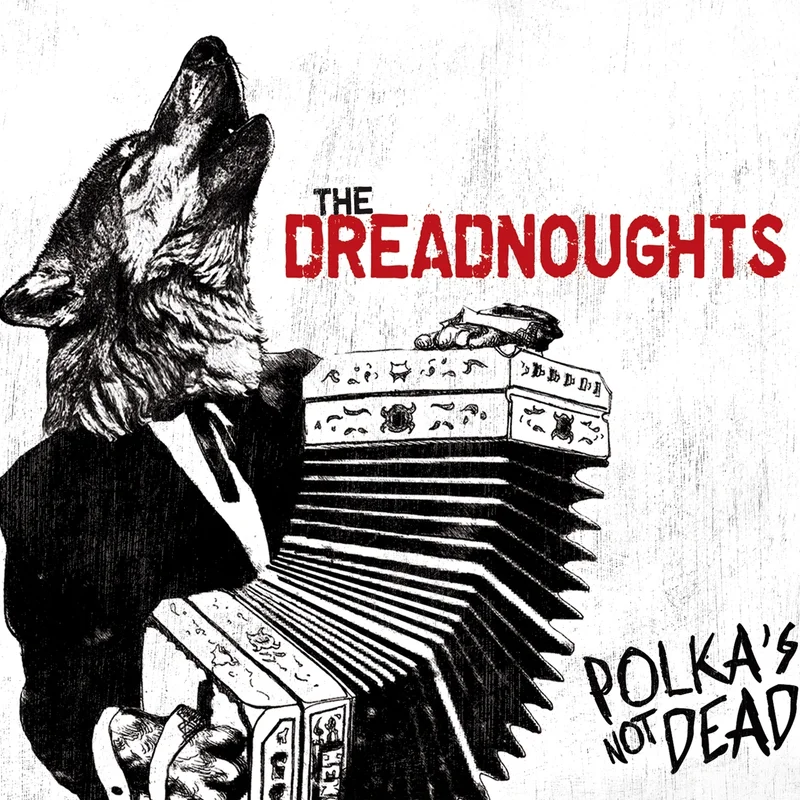
PolkaNeverDies
The Dreadnoughts
Polka's Not Dead
A riotous accordion-fueled manifesto declaring war on musical mortality itself.
Your eyes were filled with stars
So you picked up a guitar
And how the people gave
The attention that you crave
Tonight, the stage is yours
But the world has watched you rise
And fall a thousand times before
Polka never dies
So when your face is gone
The dance will carry on
And you'll rot down in your grave
With the souls you couldn't save
Tonight, the stage was yours
How they loved your moans and sighs
But oh, the reaper loved you more
Polka never dies
Come all you indie hipster darlings
And new pop country starlings,
To the main street legion hall
Look into my crystal ball
Emo, screamo, POLKA NEVER DIES
Last call, Dance hall, POLKA NEVER DIES
You'll be the first against the wall
And Polka never dies
You are the first against the wall
And Polka never dies
Your eyes were filled with stars
So you picked up a guitar
And how the people gave
The attention that you crave
Tonight, the stage is yours
But the world has watched you rise
And fall a thousand times before
Polka never dies
So when your face is gone
The dance will carry on
And you'll rot down in your grave
With the souls you couldn't save
Tonight, the stage was yours
How they loved your moans and sighs
But oh, the reaper loved you more
Polka never dies
Come all you indie hipster darlings
And new pop country starlings,
To the main street legion hall
Look into my crystal ball
Emo, screamo, POLKA NEVER DIES
Last call, Dance hall, POLKA NEVER DIES
You'll be the first against the wall
And Polka never dies
You are the first against the wall
And Polka never dies
“A riotous accordion-fueled manifesto declaring war on musical mortality itself.”
In the mid-2000s, Vancouver's waterfront was teeming with a peculiar breed of punk — one that smelled of spilled beer, sea salt, and the bellows of a well-worn accordion.
The Dreadnoughts, born from the collision of folk traditions and punk fury, had been honing their craft in the pubs and legion halls of British Columbia when they began assembling what would become their defining statement.
"Polka's Not Dead," their 2009 sophomore album, was both a love letter and a battle cry, and no track embodied that duality more ferociously than its centerpiece anthem, "Polka Never Dies." The song emerged during a period when the band — led by Nicholas Smyth — was grappling with the tension between their devotion to "uncool" folk forms and the relentless churn of indie trends that surrounded them.
It was written not in a moment of nostalgia, but in a moment of defiance.
Sonically, "Polka Never Dies" is a masterclass in controlled chaos.
Clocking in at a breathless 142 BPM in the bright, triumphant key of C major, the track wastes no time establishing its thesis: this is music built for movement, for sweat, for communal ecstasy.
The production is deliberately raw, capturing the band's live energy with minimal studio polish.
Accordion and tin whistle weave around distorted guitars, while the rhythm section drives with the relentless insistence of a freight train barreling through a Bavarian beer hall.
The energy rating of 0.86 is no abstraction — you can hear it in every compressed snare hit, every gang vocal that erupts from the chorus like a crowd that has collectively decided that standing still is no longer an option.
Yet beneath that exuberance lives a valence of 0.53, a bittersweet undercurrent that gives the song its surprising emotional depth.
The lyrics operate on multiple levels simultaneously, and therein lies the song's genius.
On the surface, it reads as a sardonic eulogy for every flash-in-the-pan musical trend — the "indie hipster darlings" and "new pop country starlings" who rise and fall with the algorithmic tides.
But dig deeper, and Smyth is wrestling with something more existential: the relationship between art and mortality.
"You'll rot down in your grave / With the souls you couldn't save" is not just a jab at fleeting fame; it's a meditation on the futility of ego in the face of death.
The song's emotional arc moves from seduction ("Your eyes were filled with stars") to decay ("the reaper loved you more") to transcendence ("the dance will carry on").
The recurring declaration that "Polka Never Dies" becomes less a genre statement and more a philosophical proposition — that communal, participatory music outlives the individual, that the dance is eternal even when the dancer is dust.
The line "You are the first against the wall" borrows revolutionary language to position polka not as quaint nostalgia but as genuine cultural resistance.
When "Polka's Not Dead" dropped in 2009, it arrived in a musical landscape dominated by synth-pop revivals, post-punk garage rock, and the early stirrings of EDM's mainstream takeover.
The Dreadnoughts were, by any conventional measure, swimming against every current.
And yet the album, and "Polka Never Dies" in particular, found a fervent audience.
The folk-punk community — already galvanized by bands like Flogging Molly and Gogol Bordello — embraced the track as an anthem, but its reach extended further, becoming a staple at festivals from Punk Rock Bowling to European folk gatherings.
Critics who bothered to look past the novelty of the genre tag found a band operating with genuine craft and philosophical weight.
The song became a viral favorite years after its release, finding new life on streaming platforms and social media, where its message of artistic resilience resonated with a generation exhausted by disposability.
More than fifteen years after its recording, "Polka Never Dies" endures as both prophecy and proof of concept.
The emo bands referenced in its lyrics have largely faded; the screamo acts have dissolved; the indie darlings of 2009 are mostly forgotten.
And yet The Dreadnoughts continue to fill halls, and this song continues to fill dance floors.
It stands as the definitive track in their catalog — the moment where humor, philosophy, musicianship, and raw punk energy achieved perfect synthesis.
In the broader history of folk-punk, it occupies a singular position: a song that doesn't just celebrate a marginalized genre but argues, with intellectual rigor and visceral power, for the supremacy of participatory music over spectacle.
Every time an accordion is unsheathed at a punk show, every time a mosh pit transforms into a polka circle, the song's thesis is proven anew.
The dance carries on.